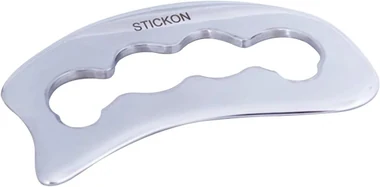
STICKON-33
Guide
Marks, pressure and knowing when to stop
Why scraping leaves colour, what a bruise actually is, and the signs that mean put the tool down.
The first session with a steel tool usually ends with red skin and a question. Some of the colour fades in an hour. Some of it turns into a proper bruise that stays for a week, and people then wonder whether they did something wrong.
Often they did. Pressure is the usual culprit, speed is the second, and dry skin is the third.
What a bruise is
MedlinePlus, the public health library of the National Library of Medicine, puts it in one sentence.
“A bruise is a mark on your skin caused by blood trapped under the surface. It happens when an injury crushes small blood vessels but does not break the skin.”
MedlinePlus, U.S. National Library of Medicine, Bruises. Read 12 September 2026.
That is the mechanism behind the marks a scraper leaves. Small vessels under intact skin break and leak. The same page gives the timeline and the line at which a bruise stops being ordinary.
“See your health care provider if you seem to bruise for no reason, or if the bruise appears to be infected.”
MedlinePlus, U.S. National Library of Medicine, Bruises. Read 12 September 2026.
Bruising for no reason is the phrase to hold on to. If light work leaves heavy colour, the tool is not the interesting part of that story.
Pressure, in practical terms
Use enough oil that the edge slides rather than drags. Work along the muscle, not across bone. Keep each pass slow, count six or eight passes over one area, then move on.
The feeling you want is a dull ache that eases as you work. Sharp pain is a stop signal, not a sign of progress. Neither is holding the tool still and grinding.
Skip any area that is hot, swollen or freshly injured. The national description of an acute injury names the symptoms plainly.
“Sudden, severe pain.”
National Institute of Arthritis and Musculoskeletal and Skin Diseases, NIH, Sports Injuries. Read 12 September 2026.
Those belong to a clinic visit, not to a session at home. The same source draws the line between a sudden injury and the slow kind that comes from repeating a motion.
“Chronic injuries, which are usually related to repetitive loading or overuse and develop gradually over time.”
National Institute of Arthritis and Musculoskeletal and Skin Diseases, NIH, Sports Injuries. Read 12 September 2026.
Who should ask first
Anyone on blood thinners. Anyone with a clotting or bleeding disorder. Anyone with fragile skin, a recent surgery, or a diagnosis that involves the veins. Pregnancy is another conversation for a clinician rather than a product page.
The published summary of harm from manual work is short but not empty, and it is worth reading in full on the research guide before a first session.
Care of the tool itself
Steel is easy. Wipe the tool after use, wash it with soap and warm water, dry it fully and keep it out of the drawer full of keys. Oil left on a polished face turns sticky and pulls at the skin next time.
One tool per person if the skin is broken anywhere, and the same rule in a clinic, where it is not optional.
Polished steel scratches. A scratched face drags, so the tools that live loose in a gym bag stop feeling smooth long before they stop working.
Tools people start with
See more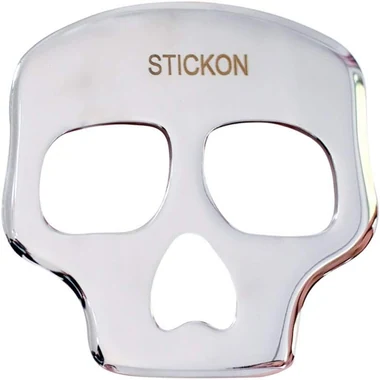
Stainless Steel Gua Sha Massage Tool - Great Soft Tissue Mobilization -
4.8″ long 4.9 out of 5 (41) $34.99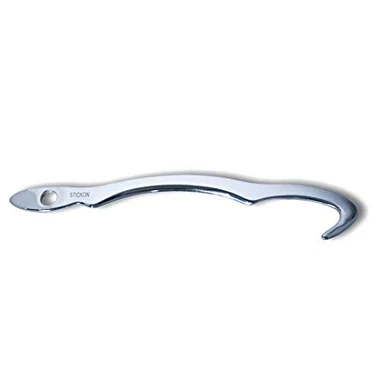
STICKON-07
Stainless Steel Gua Sha Scraping Massage Tool IASTM Tools Great Soft
Back and spine · Neck and jaw 4.8 out of 5 (23) $44.99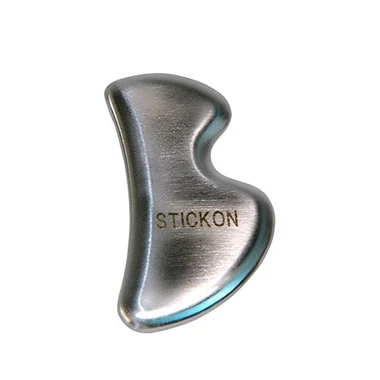
B
Stainless Steel Gua Sha Scraping Massage IASTM Soft Tissue Mobilization
5.11″ long · 2.8 oz 4.7 out of 5 (6,021) $9.99Sources
- Bruises, MedlinePlus, U.S. National Library of Medicine. Read 12 September 2026.
- Sports Injuries, National Institute of Arthritis and Musculoskeletal and Skin Diseases, NIH. Read 12 September 2026.